
P-ISSN: 0974-889X University website
International Journal of Educational Research, Development and Extension E-ISSN Applied · Quarterly · Published by Centre for Educational Research, Madurai Kamaraj University
Submit an article
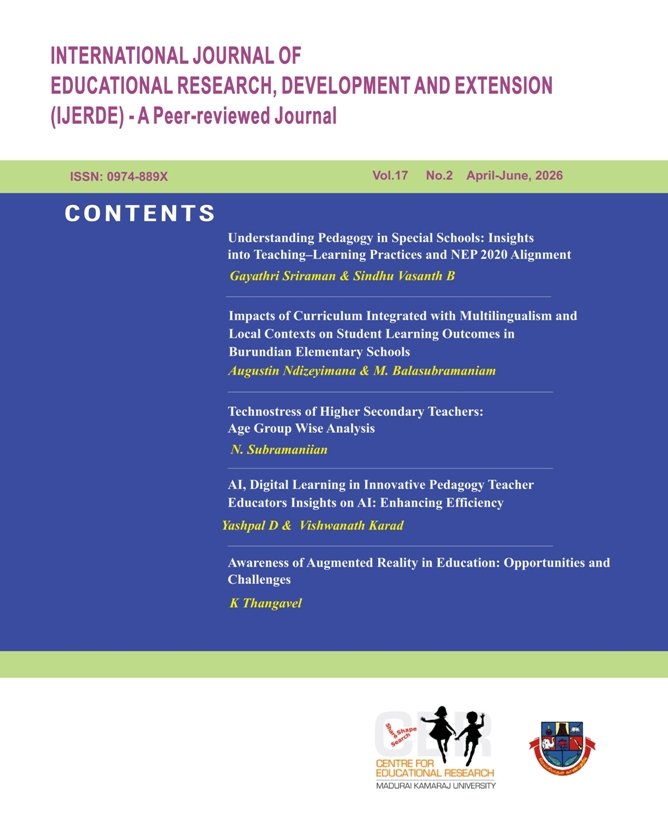
Cover of Volume 17, Issue 2

Archives

Volume 17, Issue 2

Volume 17, Issue 2 Apr-Jun 2026 Pages 7–57 5 articles

Articles

Articles

Understanding Pedagogy in Special Schools: Insights into Teaching– Learning Practices and NEP 2020 Alignment

Gayathri Sriraman, Dr. Sindhu Vasanth B

Pages: 7–23 First published: 11 May 2026

Abstract

The National Education Policy (NEP, 2020) emphasizes inclusive, flexible, and learner-centred pedagogical practices, particularly for children with diverse learning needs. Special schools often require adaptive instructional approaches, including multisensory, individualized, and psychologically informed methods. This qualitative study examines the teaching–learning practices employed by special educators and evaluates their alignment with the recommendations outlined in the NEP 2020. Approximately 20 participants—comprising special educators and related school-based professionals—will be interviewed using semi-structured interviews to explore current pedagogical practices and the challenges encountered during implementation. The data will be analysed using Braun and Clarke’s thematic analysis to identify patterns related to classroom strategies, learner support mechanisms, and congruence with policy guidelines. The study aims to contribute meaningful insights toward strengthening innovative, inclusive, and developmentally appropriate teaching approaches within the context of special education settings.

Full text PDF

Articles

Impacts of Curriculum Integrated with Multilingualism and Local Contexts on Student Learning Outcomes in Burundian Elementary Schools

Augustin Ndizeyimana, Dr. M. Balasubramaniam

Pages: 24–33 First published: 11 May 2026

Abstract

This study will investigate the impacts of a curriculum that integrates multilingualism and local contextual knowledge on the pupils of primary school at an early age in Burundian elementary schools, who are not mature enough to determine how to differentiate between different languages, and the study will also deal with knowing how are their academic outcomes. Based on the multilingualism integrated in the elementary school from the lower level of elementary school, this study will explore how the integration of French, English, Kiswahili, and Kirundi is managed by the learner and their outcomes. Using a survey research design, data will be collected from teachers, students, and the school leaders from Bujumbura province. To gather data, the structured questionnaire will be employed, using Google Forms, and will be analyzed by suitable statistical analysis. The expected findings are that the students and teachers are exposed to a multilingual context in their teaching and learning that they don’t understand well, and the responsive curricula can bridge cultural gaps in early grade achievement. The study recommends that the government of Burundi first encourage the professional development of teachers by focusing on language learning.

Full text PDF

Articles

Technostress of Higher Secondary Teachers: Age Group Wise Analysis

N. Subramaniian

Pages: 34–40 First published: 11 May 2026

Abstract

According to Muddanagousa Patil (2016), stress is a natural aspect of modern living and is expected to rise as life becomes more complex. For teachers, technostress—which results from the unanticipated spread of technology— presents a serious obstacle. Increased workloads are a result of technology's unchecked growth and its detrimental effects on almost half of the population. In today's environment of rapid change, employees cannot adapt to technology by relying just on individual efforts.The study's goal was to investigate higher secondary teachers' technostress in relation to age groups. Using the descriptive survey approach, the current study was carried out on ten schools in Tamilnadu's Tenkasi District. Using basic random sampling, the researcher selected 300 secondary school teachers as a sample. The Technostress Scale (Tarafdar et al., 2007) was the only instrument the researcher utilized to gather data for the study. According to the study, higher secondary teachers in the 36–50 age range experience more technostress than those in the 35–35 age range.

Full text PDF

Articles

AI, Digital Learning in Innovative Pedagogy Teacher Educators Insights on AI: Enhancing Efficiency

Dr. Yashpal D. Netragaonkar, Dr. Vishwanath Karad

Pages: 41–48 First published: 11 May 2026

Abstract

The study is concerned with the perceptions of Teacher Educators about Artificial Intelligence (AI) in education with particular emphasis on how AI can support productivity in school settings. The study draws from constructivist learning theory, cognitive load theory, TAM, and STST, representing learning theories that can guide the application of AI. The study considers learning theories that can guide the use of AI, including constructivist learning theory, the cognitive load theory, TAM and the socio-technical systems theory. The study employed the descriptive survey design. The data obtained from the Teacher Educators were analysed quantitatively to check for trends and/or high percentage of agreement for the key areas. The results show the percentages of positively perceived benefits of using AI in learning and the scores of the level of agreement for these positively perceived benefits: The amount of agreement is high: AI improves educational outcomes, AI can support lesson preparation, there is a confident high level of agreement that AI can be used for data-driven monitoring of student progress, and overall, there is generally high level of agreement that AI can enhance student engagement. Meanwhile, only moderate levels of awareness on the part of respondents are emerging of AI and significant concerns about job loss, data privacy, and security are acknowledged, despite the general lack of confidence in AI at this moment. It is recommended that the study's key findings be applied to effective integration of AI in teaching by applying a complementary rather than replacement strategy that provides proper professional development, institutional support, and guidance on ethical and equity themes with a policy directive.

Full text PDF

Articles

Awareness of Augmented Reality in Education: Opportunities and Challenges

Dr. K. Thangavel

Pages: 49–57 First published: 11 May 2026

Abstract

Learning as we know it is being reimagined with the help of augmented reality (AR). It enables students to view digital images and information overlaid on the real world. That sounds exciting. However, the issue is. Not many schools actually use it. It's a subject that people don't know enough about. This study analyzed the actual knowledge of the teachers and students about AR. The researcher also inquired about the positive aspects they have observed and the challenges that hinder them. A survey called AREAS was used. Two hundred people took part in the study. The result was an interesting process. Students were more knowledgeable than teachers. Their scores for basic knowledge were higher (M = 3.42, SD = 0.76) compared to teachers (M = 2.91, SD = 0.88). It was similar when it came to understanding the use of AR in class. The students' score was 3.67 and the teachers' score was 3.02. Big differences indeed. In contrast, teachers expressed greater concern about issues. They scored a 3.55 barrier compared to students who scored a 3.28 barrier. The top concern was monetary and seventy-four percent of respondents reported cost as a major concern. Training came next. Of this, 68% reported not receiving enough training. It had nothing to do with gender. Men and women perceived AR in the same manner. Then, what does this imply? Students are ready. Teachers are not supported, however. The researcher proposes to provide teachers with enhanced professional development with an emphasis on real classroom practice. That's where AR can truly aid students in learning better if schools invest in AR tools and technical support in a proper manner.

Full text PDF